
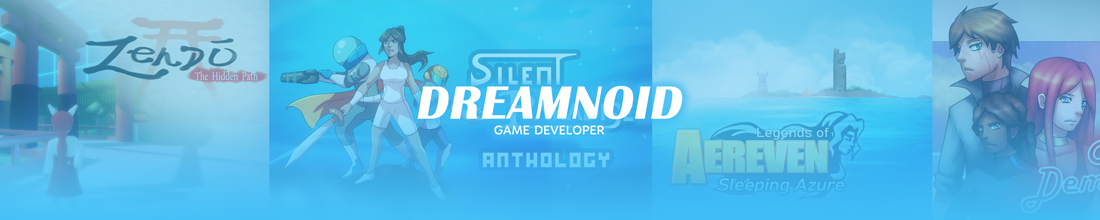
What is Dreamnoid?
Dreamnoid is a label. It's the name I use to make and publish my games and stories.
My actual nickname is Dri, I'm a AAA game programmer also making indie games in my spare time. I make them entirely myself and (mostly) from scratch using custom tech.
I love storytelling. I wrote a few novellas and novels (some of them published) and my love for video games is an extension of that. I'm not a "gameplay first" type of player: I play to be immersed in rich, interactive worlds full of fascinating characters.
That's why I enjoy making action-adventure games and role-playing games.
Where to start
I've made around a dozen games so far. Some are on Steam, the rest are on Itch.
If you enjoy metroidvanias, Silent Paradise Anthology is a good place to start. For Zelda fans, check out my Legends of Aereven series. RPG enthusiasts, I recommend to you Hotel Demonica.
My philosophy
My approach to game development is closer to a novelist than it is to a regular game studio. I’m aiming for a smaller, more sustainable way of working.
I've seen developers work on the next indie sensation for half a decade, burning through all their savings and still be buried under an ever increasing volume of released games. I wanted to try something different.
This is why I work alone and don’t spend 3 years on a single game and hope release day pays off. Instead, my goal is to publish smaller games more often, to build and maintain a back catalog. You can start wherever you want, they're all standalones, but deeper connections build to something bigger.
Most of my games look retro, with low-resolution 2D pixel-art, but I don't advertise them as such. They're not necessarily meant to evoke nostalgia. It's simply the natural intersection of "What I think looks good", "What I can make on my own" and "What can be expected to run on present and future hardware".
My tech
Most players will only discover my games long after their initial release, so I need them to last.
It’s half the reason why I create my own custom game engines.
Taking inspiration from the worlds of virtual machines, emulation and fantasy consoles, my games are made for a virtual hardware that can be easily ported and preserved.
Another reason for using custom tech is so I can build tools tailored to my workflow, to help me do more and work faster.
Because my engines and tools are so specialized, there's no sense in sharing them publicly, but I still write about them if you're curious.